TypingMind: Agentic Mode & Local Knowledge Base Integration
FEATURE REQUEST
TypingMind: Agentic Mode & Local Knowledge Base Integration
A strategic case for why TypingMind must evolve from a chat frontend into a local-aware, agentic platform — or risk being made obsolete by tools that already do.
1. Executive Summary
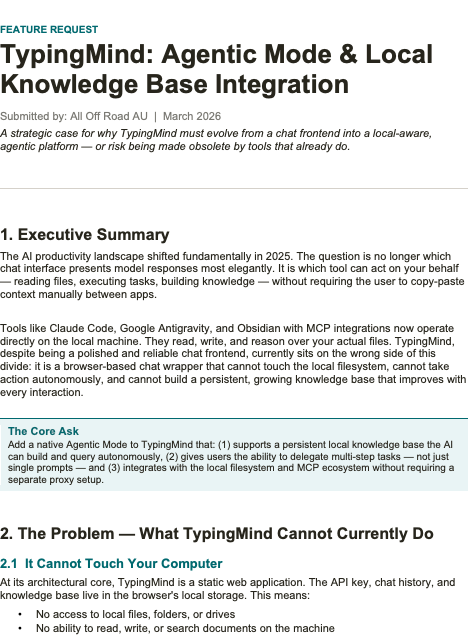
The AI productivity landscape shifted fundamentally in 2025. The question is no longer which chat interface presents model responses most elegantly. It is which tool can act on your behalf — reading files, executing tasks, building knowledge — without requiring the user to copy-paste context manually between apps.
Tools like Claude Code, Google Antigravity, and Obsidian with MCP integrations now operate directly on the local machine. They read, write, and reason over your actual files. TypingMind, despite being a polished and reliable chat frontend, currently sits on the wrong side of this divide: it is a browser-based chat wrapper that cannot touch the local filesystem, cannot take action autonomously, and cannot build a persistent, growing knowledge base that improves with every interaction.
2. The Problem — What TypingMind Cannot Currently Do
2.1 It Cannot Touch Your Computer
At its architectural core, TypingMind is a static web application. The API key, chat history, and knowledge base live in the browser's local storage. This means:
• No access to local files, folders, or drives
• No ability to read, write, or search documents on the machine
• No way to execute actions in other applications
• No persistent memory that survives beyond what the user manually uploads
By contrast, Claude Code runs directly in the terminal and has full filesystem access. Google Antigravity operates as a desktop IDE-class agent that can spawn parallel sub-agents, browse the web, and execute shell commands. Obsidian, when connected to Claude via MCP, becomes a live vault that the AI reads and writes in real time.
2.2 Its Knowledge Base Is Passive, Not Agentic
TypingMind's Knowledge Base (KB) is a manual upload system backed by RAG. The user uploads a document, TypingMind chunks and embeds it, and the model retrieves relevant chunks at query time. This is useful — but it is frozen in time. The knowledge base does not:
• Grow based on your conversations
• Automatically index files from folders on your machine
• Allow the AI to create new entries when it discovers something noteworthy
• Connect to a living file system the way Obsidian or Claude Code does
In an agentic workflow, the AI is not a passive question-answering tool. It is an active participant that can read a document, extract the key points, write a summary back to the KB, and then use that summary in future conversations — without the user doing any of that work manually.
2.3 It Cannot Delegate — It Can Only Respond
TypingMind operates on a synchronous, one-prompt-one-response model. Every task requires the user to frame it, submit it, review the result, re-prompt, and repeat. Tools like Claude Code and Antigravity operate on a task-oriented model where you describe an outcome and the agent plans the steps, executes them in sequence, and reports back — often without further human input.
3. The Competitive Landscape — What Has Already Moved On
3.1 Claude Code
Anthropic's own CLI-based agent has full local machine access, reads and modifies entire codebases, executes shell commands, manages files, and can chain multi-step operations autonomously. It works inside the terminal — not a browser. The implications extend beyond coding: users are increasingly using Claude Code for writing, research workflows, and any task that involves reading existing files and producing output.
3.2 Google Antigravity
Launched in November 2025, Antigravity is a desktop-class agentic development platform. Its 'Manager Surface' lets users dispatch multiple independent agents simultaneously, each working on a different task across the editor, terminal, and browser. Agents produce Artifacts — screenshots, implementation plans, walkthroughs — as verifiable deliverables. Critically, Antigravity supports a learning layer that allows agents to save useful context and code snippets to a knowledge base to improve future tasks. This is exactly the capability TypingMind's KB lacks.
3.3 Obsidian + MCP + Claude
The combination of Obsidian as a local Markdown vault, the Model Context Protocol (MCP), and Claude Code has created a powerful open architecture. The vault is a live knowledge base — plain files on disk — that any MCP-compatible agent can read, search, and write to. Claude Code connected to an Obsidian vault can cross-reference hundreds of notes, create new entries that fit the existing structure, and operate on the knowledge base as an active workspace. This requires zero upload steps. The files are simply there, on disk, as they always were.
3.4 TypingMind with Filesystem MCP (Partial Solution)
TypingMind does support MCP servers — but only in the Personal edition, not Teams, and only via a separately running local MCP bridge process. This is a technically demanding setup that most users will not configure correctly. More importantly, it is bolted on as an afterthought rather than a first-class, integrated capability. The result is fragile, undiscoverable, and not available in the product tier many professional users are on.
4. Feature Requests — What Needs to Be Built
The following requests are listed in priority order. Together they would transform TypingMind from a premium chat frontend into a platform competitive with the agentic tools that are currently eclipsing it.
5. Priority #1 Deep Dive — Local Knowledge Base Sync
5.1 What It Should Do
The user specifies one or more local folders. TypingMind watches those folders and automatically indexes their contents into the Knowledge Base using the same RAG pipeline already in place. Changes to files are reflected incrementally — no manual re-upload required.
The AI should also be permitted to write back to a designated output folder: summaries, research notes, extracted key points. Over time, the knowledge base becomes richer with every interaction — not because the user is doing extra work, but because the AI is.
5.2 Why This Is Different From the Current KB
• Current KB: static, manual, upload-triggered
• Proposed KB: live, automatic, bidirectional
• Current KB: isolated from the actual files you work with
• Proposed KB: a mirror of your real working documents
• Current KB: AI can only read from it, not write to it
• Proposed KB: AI can read and create entries, building institutional memory
5.3 Technical Path
This is achievable without a fundamental re-architecture. The required additions are:
• A desktop companion process (lightweight, native macOS/Windows) that watches folders using the OS file-watching API and pushes changes to the TypingMind KB via the existing API
• A write-back API endpoint that allows agents to create new KB entries
• UI for specifying watched folders, reviewing AI-written entries, and setting KB write permissions
The filesystem MCP server already handles the underlying file-watching capability. The work is integrating it into the TypingMind product layer as a first-class feature, not a power-user configuration.
6. The Strategic Risk — What Happens If This Is Not Built
TypingMind has succeeded by being a thoughtfully designed, API-key-friendly chat interface at a one-time price. That proposition was compelling when the alternative was ChatGPT's subscription wall. In 2026, that is no longer the comparison being made.
Users who start using Claude Code, Antigravity, or Cursor do not come back to chat frontends for serious work. The workflow shift is irreversible: once you experience an AI that operates on your actual files and executes tasks autonomously, a browser-based prompt box feels like a regression. TypingMind risks becoming the tool people keep open for quick casual prompts while doing all meaningful work elsewhere.
The good news is that TypingMind already has most of the underlying infrastructure: a KB pipeline, MCP support, an agent system, and a plugin architecture. The gap is integration — pulling these threads together into a coherent agentic experience that works without advanced configuration. That is a product design problem, not a technical one from scratch.
7. Summary of Requests
Listed by business impact:
8. Closing Statement
TypingMind has built genuine goodwill with power users who appreciate its clean design, one-time pricing, and flexibility across model providers. That foundation is worth protecting — but it will not protect itself.
The shift to agentic AI is not a feature trend. It is a redefinition of what AI tools are for. A chat interface that cannot act on the user's computer is, by definition, only half a tool in 2026. The requests in this document are not about adding features for the sake of a changelog. They are about whether TypingMind remains relevant to the users who currently like it most — the technically literate, heavy users who will be the first to leave when a better option fully matures.
Log in to comment and vote
No comments yet
Be the first to share your thoughts.